


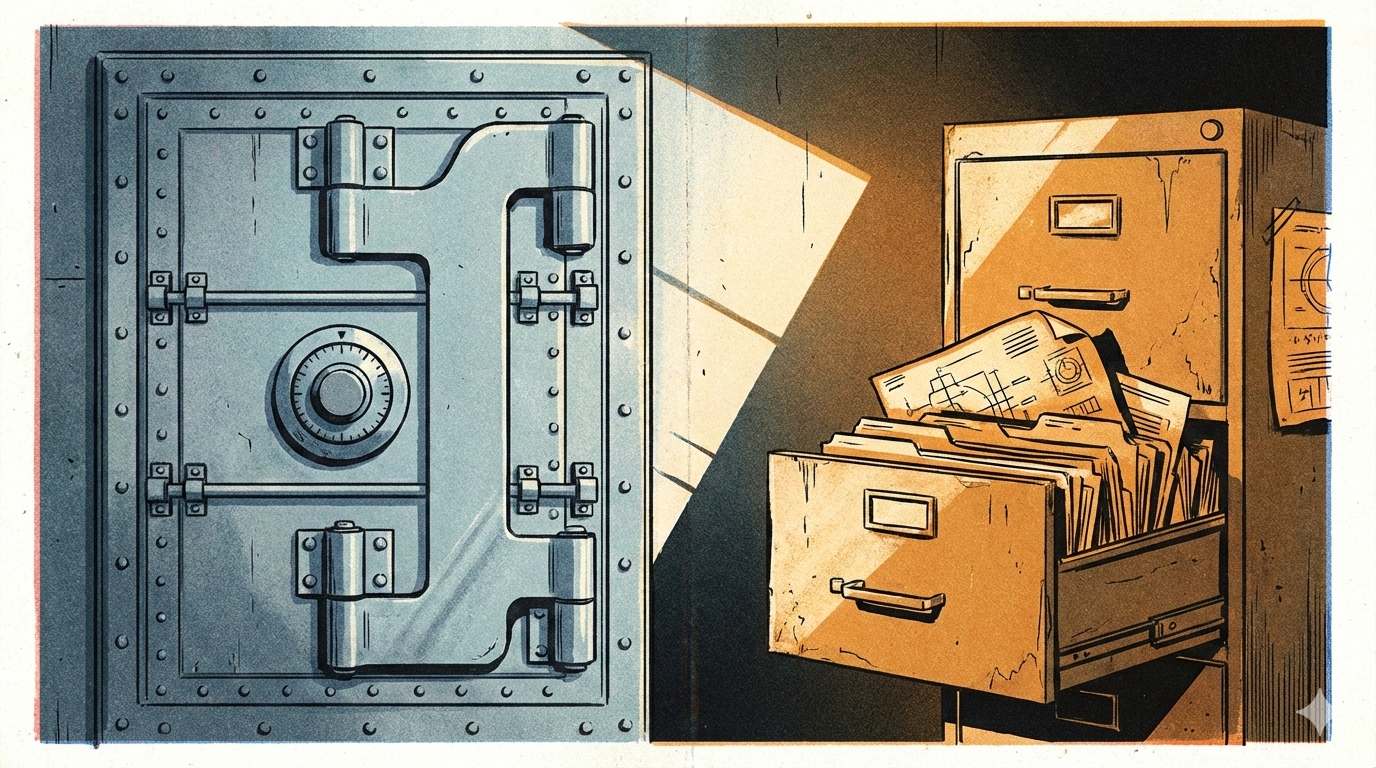
Most founders assume that protecting a valuable innovation means filing a patent. It’s the default move.
But I see this create real strategic problems. Patents require you to publicly disclose exactly how your innovation works – in exchange for a 20-year monopoly. Once that application is public, your competitors know precisely what you built and how.
Sometimes the smarter move is to never tell them.
Two Very Different Kinds of Protection
A patent gives you an exclusive right to commercialize your invention. In exchange, the government publishes your technical details for the world to read. After 20 years, it’s public domain.
A trade secret gives you protection with no expiration date – as long as the information stays confidential. No filing required. No public disclosure. No clock running.
Coca-Cola’s formula has been a trade secret for over 130 years. They could have patented it. They chose not to. That decision has held up remarkably well.
When a Patent Is the Right Call
Patents make sense in specific situations:
When competitors could reverse-engineer your product. If someone can buy your device, take it apart, and figure out how it works – a trade secret offers you nothing. A patent at least gives you legal recourse when they copy you.
When you want licensing revenue. You can’t license a secret. If your innovation has value beyond your own use, patents create a monetizable asset.
When the innovation has a long commercial life. If your process or product will still be relevant in 15 years, a 20-year monopoly is worth the disclosure tradeoff.
When Trade Secrets Are Strategically Smarter
For many of the manufacturing and tech companies I work with, trade secret protection is actually the stronger play.
When the innovation is impossible to reverse-engineer. A manufacturing process that happens inside your facility, using proprietary equipment, with steps your competitors can’t observe – that’s a trade secret candidate. No one can file a patent workaround if they don’t know what you’re doing.
When your process evolves continuously. Patents protect a specific, static invention. If your team is constantly improving your process, you’d be filing new patents constantly – and disclosing your roadmap every time. Trade secret protection moves with you.
When speed matters more than exclusivity. Patent prosecution takes 2-4 years. If your competitive window is shorter than that, secrecy gives you protection immediately.
The Part Most Companies Get Wrong
Trade secret protection isn’t passive. It doesn’t happen automatically just because you haven’t told anyone.
Courts look at whether you took “reasonable measures” to protect the information. If you didn’t, you lose trade secret status – and with it, your legal protection.
What reasonable measures actually look like:
- NDAs with every employee and contractor who touches the information (signed before access, not after)
- “Confidential” or “Proprietary” markings on relevant documents and files
- Access controls – only the people who need to know should know
- Physical security for processes that happen on-site
- Clear internal policies on what’s confidential and how it’s handled
One gap in this chain can cost you the protection entirely. I’ve seen companies lose trade secret claims in litigation because their own employees didn’t know the information was supposed to be secret.
The Framework I Use With Clients
Three questions to work through:
- Can a competitor discover this by studying your product or process? If yes, lean toward patent. If no, trade secret is viable.
- Does the innovation have a defined lifespan, or will it keep evolving? Static innovation = patent candidate. Continuously evolving = trade secret candidate.
- Do you have the operational discipline to protect it? Trade secrets require ongoing commitment. If your organization can’t maintain confidentiality protocols, a patent may be more reliable protection.
Most companies I work with have at least one innovation that belongs in the trade secret category – and they’ve never thought about it that way.
What’s your default assumption when you create something valuable in your business – patent first, or have you ever gone the trade secret route? I’m curious what’s driven those decisions.
Elliott Alderman brings 40+ years of IP law experience to The Garcia-Zamor Law Firm, including his work as a former U.S. Copyright Office attorney and outside counsel to the Miami Heat. He advises clients on IP strategy across patents, trademarks, trade secrets, and licensing. For questions about protecting your competitive advantage, visit garcia-zamor.com or call (410) 531-9853.