


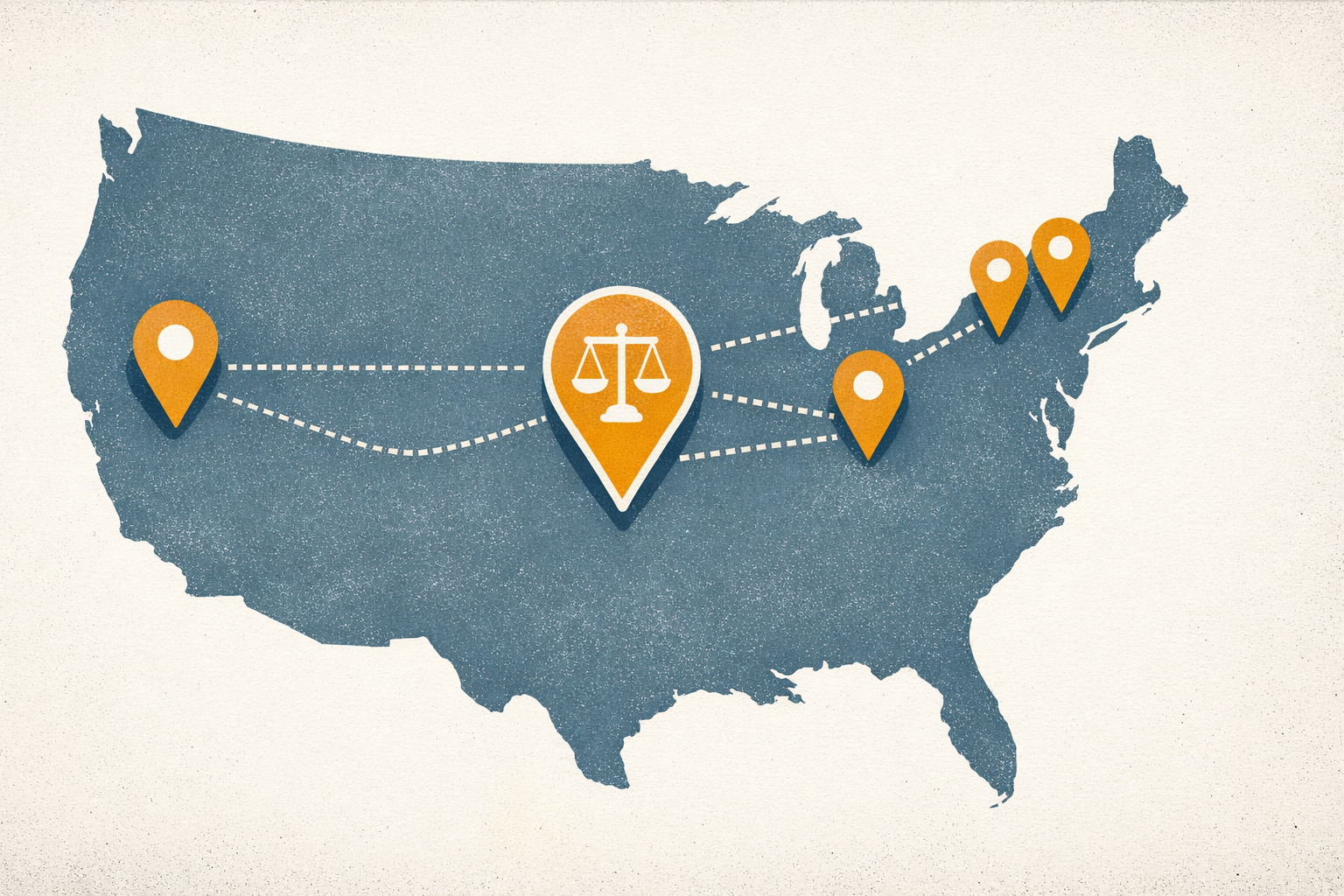
Most founders in the $1.5M to $3M revenue range have at least one remote employee working from a state where their company has never had a physical presence. Often it happened fast: a strong candidate, a competitive offer, a quick “yes” before anyone thought through the legal implications.
That decision felt simple at the time. Terminating that employee – if it ever comes to that – is anything but.
I’m Claudia Castillo, and employment law is my practice. I’m California-barred, and I work with Garcia-Zamor clients who have distributed teams across multiple states. What I see regularly: founders who built remote-friendly teams without realizing they signed up for a patchwork of state employment laws that vary significantly from where their company is headquartered.
The moment you hire someone in California, New York, or Illinois, you become subject to that state’s employment laws. Not just for that employee. For every employment action involving them, including termination.
Here are the three traps that catch companies most off guard.
Trap 1: California Final Pay Timing Is Not Negotiable
In most states, you have a pay period or two to issue a final paycheck after termination. California does not work that way.
When you terminate a California employee – meaning you initiate the separation – final pay is due on the last day of employment. Not the next scheduled pay date. Not within 72 hours. The same day.
That final paycheck must include all earned wages and any accrued, unused vacation time. California treats vacation as earned compensation, not a benefit that expires. If your company has a “use it or lose it” vacation policy, that policy is likely unenforceable for California employees.
Imagine this: you decide on a Thursday afternoon to let someone go. You need to act quickly because of a sensitive client situation. In your home state, you have a week to process final pay through your normal payroll cycle. In California, the clock starts the moment that conversation ends.
Companies that miss this requirement face waiting time penalties: one full day of wages for every day final pay is late, up to 30 days. On a $90,000 salary, that adds up to roughly $7,500 in penalties before you factor in any legal fees.
Trap 2: California Protected Categories Go Well Beyond Federal Law
Federal anti-discrimination law protects employees from termination based on race, sex, religion, national origin, age, and disability, among others. California’s Fair Employment and Housing Act extends those protections significantly.
California prohibits discrimination based on categories your home state may not recognize, including marital status, sexual orientation, gender identity and expression, military and veteran status, and political affiliation. California also provides broader protections for employees with certain medical conditions and for those exercising pregnancy-related rights.
This matters during termination because the documentation and process standards are higher. If a California employee belongs to a protected category under state law – even one your HR team did not think to flag – a termination that feels routine from your headquarters can create real exposure.
The question is not whether you intended to discriminate. The question is whether the termination can be documented clearly enough to demonstrate it had nothing to do with a protected characteristic.
Trap 3: Your Standard Documentation Process May Not Be Enough
Most companies have a termination process built around their home state’s requirements. That process probably covers the basics: a written notice, final pay processing, return of company property.
California requires more. Employers must provide specific written notices at termination, including information about unemployment insurance, state disability insurance, and paid family leave. There are also notice requirements related to COBRA continuation coverage and, in some circumstances, wage theft protection notices.
If your company operates in New York, that state has its own final pay timing rules, specific notice requirements, and additional protections for employees who raise wage and hour complaints before separation.
The documentation gap is where companies get hurt. Not because they acted in bad faith, but because they applied their home state’s process to an employee governed by a different state’s law.
Why This Matters for Distributed Teams at Your Stage
Companies in the $1.5M to $3M range are building remote teams faster than they are building the legal infrastructure to support them. One hire in a new state creates exposure that compounds with every subsequent employment action.
Having California employment law coverage embedded in your legal team – not referred out to a separate firm when a situation arises – means you are not scrambling to find specialized counsel under time pressure. That is exactly the kind of coverage Garcia-Zamor builds into client relationships across all service tiers, with Claudia’s California bar and employment law background as part of the team.
If your company has remote employees in California, New York, Illinois, or any state with strong employee protections: does your termination process account for where the employee works, not just where your company is headquartered?
Drop a comment or follow for more on multi-state employment compliance for distributed teams.
The Garcia-Zamor Law Firm provides outsourced in-house counsel combining business law and intellectual property expertise. Led by Ruy Garcia-Zamor (founder and business strategy expert), Elliott Alderman (IP specialist with 40+ years experience), and Claudia Castillo (employment law specialist), our team serves growing companies with strategic legal leadership. Learn more at garcia-zamor.com or call (410) 531-9853.