


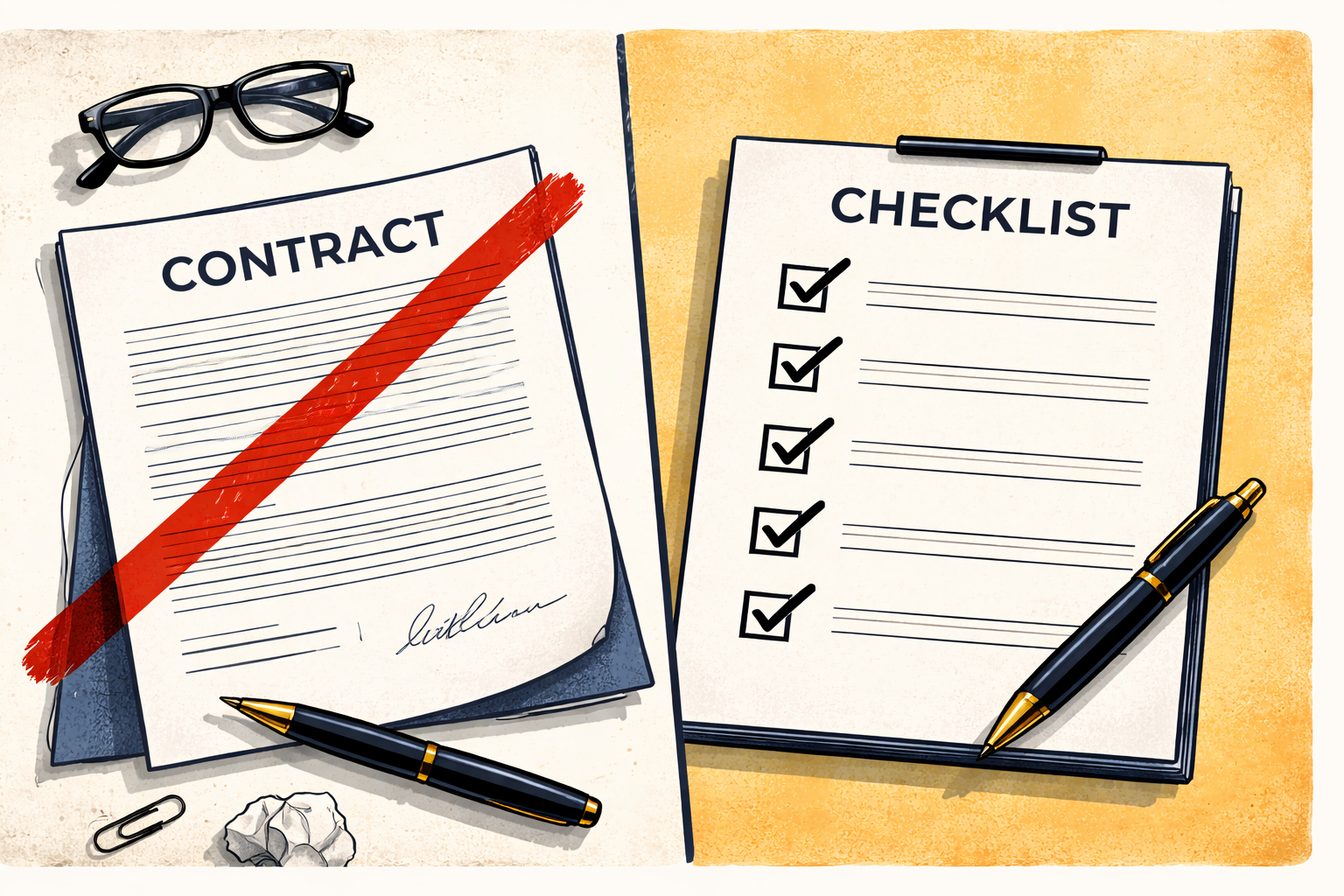
If your employment agreements still rely heavily on non-compete clauses to protect your competitive advantage, you may be building on a foundation that courts are increasingly unwilling to uphold.
The landscape has shifted significantly. Most states have either banned non-competes outright, limited them to narrow circumstances, or made them nearly impossible to enforce in practice. California, Minnesota, and several other states prohibit them entirely. Others require specific salary thresholds, advance notice, or geographic limitations so narrow the clause becomes functionally useless. [NEEDS CLIENT VERIFICATION for current 2026 legal status of specific state restrictions and FTC rulemaking status]
At the federal level, the FTC has been actively pursuing rules that would restrict or eliminate non-competes more broadly. That rulemaking has faced legal challenges and continued uncertainty. [NEEDS CLIENT VERIFICATION for current 2026 status of FTC non-compete rule and any court decisions affecting its enforceability]
Here is what I see consistently in my practice: founders and executives spend significant energy negotiating non-competes into employment agreements, then discover at the worst possible moment – when a key hire walks out the door to a competitor – that the clause is unenforceable in their state or too vague to survive a challenge.
The frustrating part is that the protection they actually needed was available the whole time. They just did not have it drafted properly.
What Courts Will Actually Uphold
When a key employee departs with sensitive knowledge, you have several tools available that are generally more durable than non-competes and more targeted to what you actually care about protecting.
Non-solicitation agreements are narrower and hold up better. Rather than broadly restricting where someone can work, they prohibit the departing employee from soliciting your specific customers or colleagues for a defined period. Courts are more comfortable enforcing these because they protect a concrete, identifiable business interest without broadly restricting someone’s livelihood.
Trade secret protections are often the most powerful instrument available, but only if you have built the supporting structure. Trade secret law protects genuinely confidential business information – customer lists, pricing strategies, proprietary processes, formulations – but courts look for evidence that you actually treated the information as confidential. That means documented protocols, access controls, and confidentiality agreements signed before the employee ever touched the information. Without that structure, “trade secret” is just a label.
IP assignment clauses in employment agreements ensure that any innovations, tools, or processes an employee develops while working for you belong to the company, not to them. This matters enormously when a senior technical employee departs and tries to use company-developed systems or methodologies at a competitor. A well-drafted assignment clause makes that structurally difficult because the IP is yours.
Garden leave provisions for senior departures are worth considering for executives and key personnel with access to your most sensitive relationships and strategies. A garden leave arrangement keeps the employee on payroll for a defined period after resignation while restricting their active work. It is more expensive than a non-compete, but it is enforceable because you are paying for it.
The Timing Problem
Most of this protection only works if it is in place before someone starts, not drafted in a hurry when they announce they are leaving.
Imagine this: a VP of Sales resigns on a Friday. She has spent three years building your most valuable client relationships and knows your pricing strategy, your pipeline, and your product roadmap. You want to protect yourself. Your outside counsel quotes you $650 an hour to draft something over the weekend. Whatever gets drafted in that window will be reactive, incomplete, and probably unenforceable in your state anyway.
Compare that to having reviewed and updated your employment agreement templates during onboarding – before anyone was hired into that role – with non-solicitation language tailored to your actual customer relationships, trade secret protocols that create a documented paper trail, and IP assignment clauses that cover the specific work product your team creates.
That is the difference between protection and paperwork.
The Practical Takeaway
Non-competes are not worthless everywhere, and there are still circumstances where they add a layer of protection worth including. But treating them as your primary defense against competitive departures is a mistake that leaves you exposed.
The alternatives are not consolation prizes. In many situations, they are more effective instruments precisely because they are narrower, more defensible, and targeted at what you actually need to protect.
If your employment agreements have not been reviewed recently, that review is worth doing now – not when someone hands you a resignation letter.
What does your current approach look like for protecting competitive information when key people leave? I’m curious what others in growing companies are navigating on this.
If you want contracts that hold, IP that’s protected, and legal bills that don’t surprise you every month – let’s talk. Garcia-Zamor Law Firm delivers fractional in-house counsel with a unique advantage: business law PLUS IP expertise, backed by 70+ years of combined experience. Passionately devoted to your success. Visit garcia-zamor.com or call (410) 531-9853.