


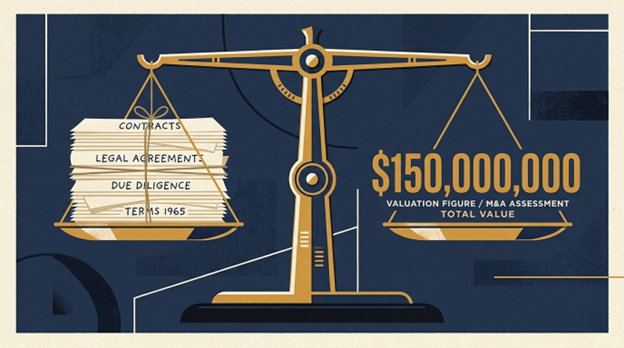
Most founders at the $2M revenue mark think about exit in terms of revenue multiples. What’s the EBITDA? What’s the ARR growth rate? How does our customer concentration look?
Those numbers matter. But in deal after deal, what actually kills or discounts acquisitions isn’t the financial story. It’s the IP story.
Acquirers and their counsel run structured IP diligence on every deal. What they’re looking for isn’t just whether you have patents or trademarks. They’re evaluating whether your IP is actually yours, whether it’s adequately protected, and whether your core product creates downstream legal exposure for them. When the answers are unclear or unfavorable, valuations drop, deal structures get complicated, or conversations end entirely.
Here’s what that diligence actually surfaces, organized into three categories I see come up repeatedly.
Category 1: Ownership Gaps
This is the most common problem, and the most preventable.
Imagine this: A company is acquired for $8M. During diligence, the buyer’s counsel requests IP assignment documentation for the three engineers who built the core platform. Two of them were contractors in the early days. The contractor agreements are generic templates from the internet. No work-for-hire language. No IP assignment clause.
The deal doesn’t die. But it restructures. A portion of the purchase price goes into escrow pending resolution. The founders walk away with less than they expected, under time pressure, negotiating from a weak position.
Ownership gaps include assignments not completed when employees or contractors contributed to core IP, early founder inventions or code that were never formally transferred to the company entity, and equity or partnership arrangements where IP ownership was assumed but never documented.
The fix is straightforward. The problem is that it requires going back and cleaning up history, which is harder and more expensive than getting it right the first time.
Category 2: Protection Gaps
Owning your IP and protecting it are two different things. Buyers evaluate both.
Unregistered trademarks in core markets are a common flag. A company operating nationally with a brand built over five years but no federal trademark registration is exposing the buyer to potential third-party claims they’d inherit with the acquisition. That creates a discount or a carve-out in the deal structure.
Core software without copyright registration is another gap that surfaces. Registration isn’t required to own copyright, but it is required to pursue statutory damages in infringement cases. Buyers know this. It affects how they value the IP as an asset.
Trade secrets without documented protection protocols are particularly significant. A trade secret isn’t protected just because it’s valuable. It’s protected because you treated it as confidential, consistently and demonstrably. If the answer to “show us your trade secret protection protocols” is a blank stare, the buyer has to assume those secrets aren’t legally protectable. That assumption changes the valuation.
Category 3: Freedom-to-Operate Gaps
This is the category that creates the most anxiety for buyers, because it’s the one that creates potential liability they’d be acquiring.
Freedom-to-operate analysis answers one question: does your core product use third-party IP in a way that creates infringement exposure?
Most companies at the $2M revenue stage have never done this analysis. That’s understandable. It’s not the first thing on a founder’s mind when they’re building and growing. But when a buyer’s counsel asks whether clearance analysis has been done and the answer is no, they have to price in the risk of unknown exposure. That uncertainty has a cost.
It doesn’t mean the deal dies. It means the buyer builds risk mitigation into the structure, often at the seller’s expense.
What This Means for Founders Thinking About Exit
These three categories share something important: none of them are difficult to address with adequate lead time. Twelve to eighteen months of proactive work clears most of these issues. The same work done reactively, under time pressure, during an active deal process, costs more, produces worse outcomes, and sometimes can’t be completed in time.
This is exactly what IP portfolio oversight in our Premium tier is designed to address. We work through ownership gaps, protection gaps, and freedom-to-operate questions on a rolling basis, not when a buyer’s counsel surfaces them under a 30-day diligence deadline.
If you’re thinking about exit, growth equity, or positioning for acquisition in the next two to three years, the time to start this work is now.
Schedule a legal strategy review and we’ll map where your IP portfolio stands across all three categories. You’ll leave with a clear picture of what’s clean, what needs attention, and how long it will realistically take to get there.
[Schedule your legal strategy review at garcia-zamor.com]
About Garcia-Zamor: We’re the fractional general counsel for innovators-protecting both your business operations and your intellectual property. Ruy Garcia-Zamor leads business growth strategy, Elliott Alderman (former Copyright Office attorney, Miami Heat IP counsel) handles intellectual property, and Claudia Castillo specializes in employment law. Contact us at garcia-zamor.com or (410) 531-9853.