


You just got the call. An investor wants to move forward, and due diligence starts in 30 days.
Here is what I see in my practice: founders who spent three years building something remarkable suddenly discover that the legal shortcuts they took at the seed stage are about to become very expensive problems. Not because the investor is looking for reasons to walk away. Because their lawyers are paid to find every gap, and they will find yours.
I have helped companies prepare for this process. The ones who go in prepared close faster, negotiate from strength, and protect their valuation. The ones who go in unprepared spend the due diligence window in crisis mode, scrambling to fix things that should have been handled years earlier.
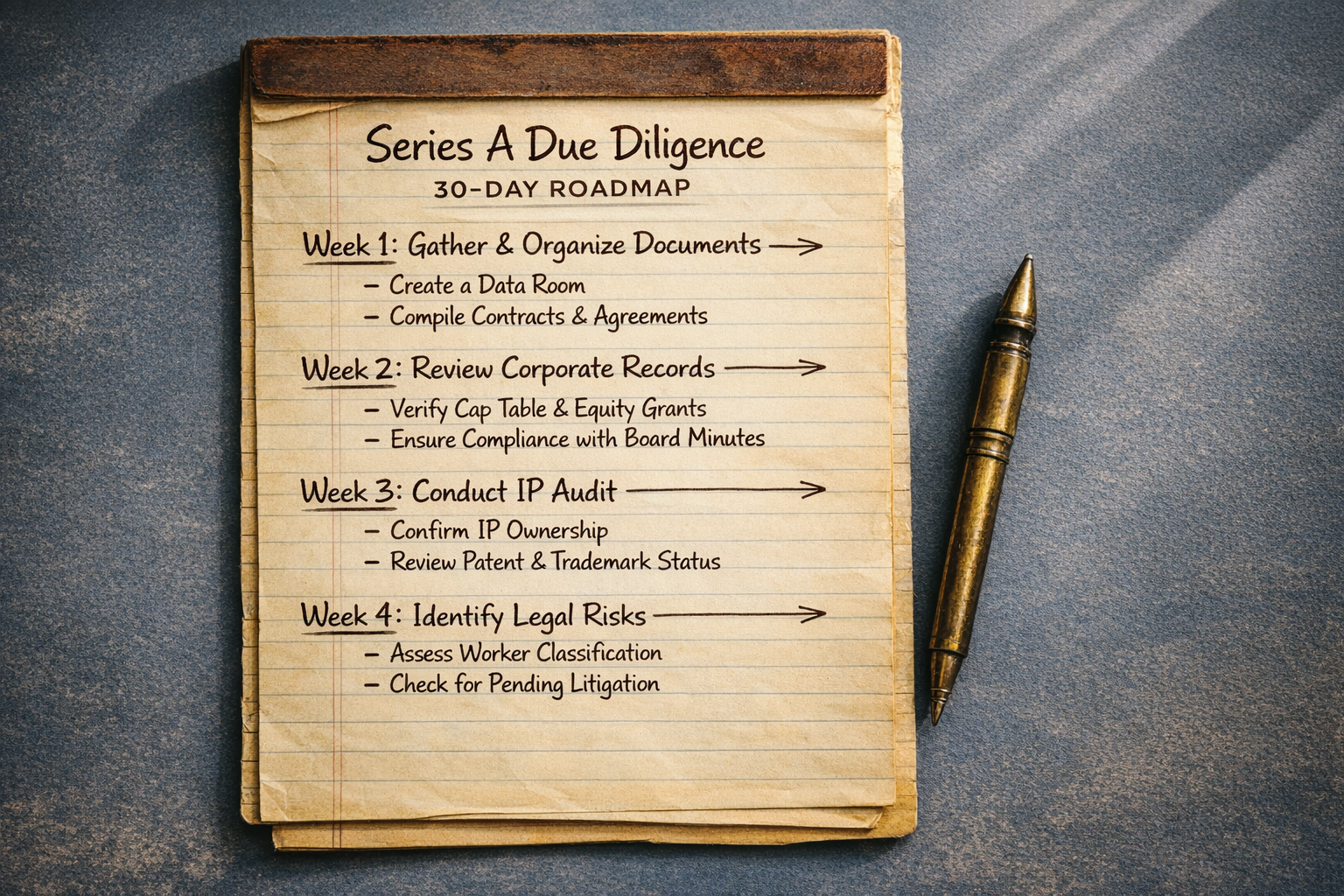
Here is the 30-day roadmap I walk my clients through.
Why Due Diligence Exposes Seed-Stage Shortcuts
Series A investors are not just buying your revenue. They are buying your legal foundation – the structure that will support the company they are betting on for the next five to seven years.
Their lawyers will request a data room. They will ask for every material contract, every equity document, every IP filing, every employment agreement. Then they will read them. All of them.
What they are looking for: clean ownership of your intellectual property, a cap table that matches your corporate records, properly documented equity grants, compliant employment practices, and no hidden litigation exposure.
What they commonly find instead: IP that was never formally assigned to the company, option grants that were approved verbally but never papered, contractors who look a lot like employees under IRS classification rules, and board minutes that do not exist.
None of these are fatal on their own. But each one slows the deal, creates negotiating leverage for the investor, or – in the worst cases – kills the transaction entirely.
The goal of the next 30 days is to find these gaps yourself before they do.
Week 1: Gather and Review Every Material Contract
Start with your paper trail. Pull every contract the company has signed and put it in one place.
Customer contracts: Are your master service agreements consistent? Do they contain IP ownership clauses that accidentally grant customers rights to your product innovations? One clause I see regularly in template agreements gives clients a license to “all work product” created under the contract – which can include proprietary features you built specifically for that engagement.
Vendor and software agreements: Does anything limit your ability to assign contracts in a change of control? Investors will ask. If a key vendor agreement requires consent to assign, that is a negotiation that needs to happen before closing, not during.
Employment agreements: Do you have signed agreements for every current employee? Do those agreements include invention assignment clauses – the language that formally transfers ownership of anything they build for the company to the company? If your early hires signed offer letters but not full employment agreements, you have a gap.
Contractor agreements: Every contractor who touched your product needs a signed agreement with work-for-hire and IP assignment language. Without it, they may own the code they wrote for you. This is not theoretical. I have seen deals restructured because a contractor who built a core feature never signed an IP assignment.
By the end of Week 1, you should have a complete inventory of what exists, what is missing, and what needs to be reviewed more carefully.
Week 2: Corporate Housekeeping
This is the work that feels administrative but matters enormously to investors.
Cap table accuracy: Your cap table needs to match your corporate records exactly. Every share issuance, every option grant, every conversion needs to be documented and reconciled. Discrepancies between your cap table and your stock ledger are a red flag that signals sloppy governance – and makes investors wonder what else does not match.
Founder vesting: This is the gap that kills more deals than almost anything else. If your founder shares are not subject to a vesting schedule with a standard four-year vest and one-year cliff, investors will require it as a condition of closing. More importantly: if you and your co-founder split equity equally but never documented what happens if one of you leaves, you have a governance time bomb. Get this documented now.
Option grants: Every option grant needs board approval, a grant date, a strike price based on a 409A valuation, and a signed option agreement. Verbal option promises are not enforceable. Options granted without a current 409A create tax liability for your employees. If you have been informal about this, Week 2 is when you fix it.
Board minutes: Investors expect to see board minutes for every major company decision – equity issuances, officer appointments, material contracts, fundraising authorizations. If your board has been operating informally, you need to reconstruct the record now. This is not falsifying documents – it is memorializing decisions that were made but never properly documented.
Week 3: IP Audit
This is where I spend the most time with companies preparing for Series A, because IP ownership is the issue that creates the most deal risk.
Trademark registrations: Are your brand name and logo federally registered? Do your registrations cover the right classes of goods and services for your current business? A trademark registration you filed two years ago may not cover a product line you launched last year.
Patent applications: If you have filed provisional patents, check your conversion deadlines. A provisional application expires 12 months after filing. If you are approaching that deadline, you need to decide whether to file a non-provisional application before due diligence begins – not during it.
Trade secret documentation: Investors will ask how you protect proprietary information. The answer needs to be more than “we have NDAs.” Do you have documented trade secret policies? Are your NDAs with employees and contractors actually signed? Do your systems restrict access to sensitive technical information on a need-to-know basis?
Open source exposure: If your product uses open source software, investors will want to know which licenses govern that code. Some open source licenses (GPL, for example) require you to release your own code under the same license – which can create significant IP complications. A quick audit of your software dependencies is worth doing before someone else does it for you.
Week 4: Risk Identification
The final week is about finding the things you do not want to find but need to know.
Litigation exposure: Is anyone threatening to sue you? Have you received cease-and-desist letters that were never formally responded to? Are there any customer disputes that could escalate? Investors will ask directly. Surprises here are far worse than disclosed risks.
Worker classification: Review every contractor relationship. The IRS test for employee versus contractor is not whether you call them a contractor – it is the nature of the working relationship. Contractors who work exclusively for you, follow your direction, and use your equipment are employees under federal law. Misclassification creates back tax liability, benefits exposure, and potential class action risk. If you have classification issues, it is better to identify and address them before due diligence than to have an investor’s lawyer surface them.
Regulatory compliance: Depending on your industry, there may be specific compliance requirements that investors will scrutinize. Data privacy (GDPR, CCPA, state-level laws) is now standard diligence for any company handling customer data. If you collect personal information, you need a privacy policy that reflects your actual practices – not a template you installed three years ago and never updated.
What a Clean Data Room Signals
When you go into due diligence with organized documentation, signed agreements, and a clear IP ownership chain, you are not just checking boxes. You are telling investors something important about how you run your business.
Clean legal foundation signals operational maturity. It tells investors that the management team is ready for the governance requirements that come with institutional capital. It builds confidence that the company they are buying into is the company they think it is.
We help companies prepare for due diligence before the term sheet arrives, not during it. The 30-day window before investors start asking questions is the best time to find gaps – when you have time to fix them on your terms, not theirs.
If you are six to twelve months from a Series A, what is the one area of your legal foundation you are least confident about right now? Drop it in the comments – I read every one, and it might be worth a post.
Ruy Garcia-Zamor is the founding attorney of The Garcia-Zamor Law Firm. He brings 20+ years of experience advising venture-backed and growth-stage companies on business law and intellectual property strategy, including work with companies ranging from early-stage startups to global technology leaders like Samsung. The Garcia-Zamor Law Firm serves as outsourced in-house counsel for growing companies – combining business legal services with IP expertise that most fractional providers cannot offer. Learn more at garcia-zamor.com or call (410) 531-9853.