

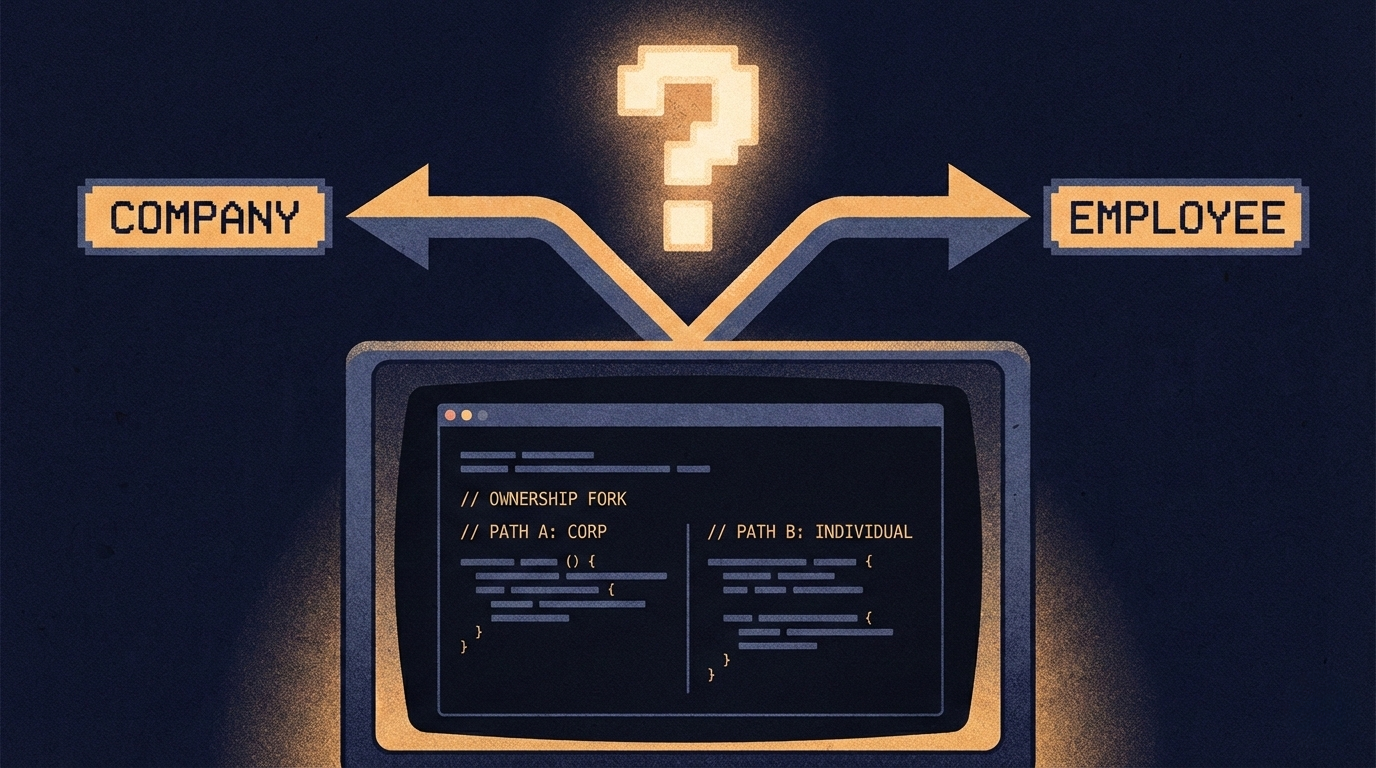
Here’s something that surprises most founders when I tell them: under U.S. copyright law, the person who creates something owns it by default.
Not your company. Them.
That developer you hired last year? The contractor who built your MVP? The engineer who wrote your core product feature? Unless they explicitly signed over those rights to your company, they own what they created – even if you paid their salary, even if they used your laptop, even if they worked in your office every day.
I see this gap constantly in growing companies. And it almost never surfaces until the worst possible moment.
The Nightmare Scenario
A founder reaches out to me after getting an acquisition offer. Exciting news, right? Then due diligence starts.
The buyer’s legal team asks: “Show us the IP assignment agreements for your development team.”
The founder goes quiet. They used a standard employment template – something downloaded years ago, maybe from LegalZoom. It covered compensation, job duties, confidentiality. But it never addressed who owns the inventions, code, and designs created on the job.
Now there’s a problem. The buyer can’t confirm the company actually owns its own product. The deal stalls. Sometimes it dies. Sometimes it closes at a fraction of the original offer, with money held in escrow until the IP ownership mess gets sorted out.
That’s not a hypothetical. That’s a pattern I’ve watched play out more than once.
Think of It Like a Property Deed
IP assignment agreements sound like legal jargon, so let me make it concrete.
Think of it like a property deed. Without the deed, you don’t own the house – even if you paid for it. Even if you’ve been living in it for years. Even if everyone around you assumes it’s yours.
IP works the same way. Without the assignment agreement, you don’t own the code – even if you paid the engineer’s salary, even if you’ve been selling the product for years, even if you’ve never thought to question it.
One document transfers ownership from them to you. That’s it.
What the Agreement Actually Needs to Say
The core of an IP assignment clause is straightforward. Something like:
“Any inventions, code, designs, or innovations you create as our employee – or as a result of your work for us – belong to the company, not to you.”
In practice, a properly drafted agreement goes a bit deeper than that. It should cover work created during employment, work created using company resources, and work that relates to the company’s business even if done on personal time. But that single sentence captures the essential transfer that most LegalZoom templates miss entirely.
When to Get It Signed
Before the first day of work – this is ideal. Make it part of the offer letter process. No awkwardness, no negotiation, just standard documentation.
During onboarding – still acceptable. If someone is already working and you haven’t done this, handle it in their first week alongside other paperwork.
Retroactively – better late than never. If you have engineers or contractors who have been with you for months or years without a signed assignment, you can still get them to sign one. It won’t cover everything retroactively, but it stops the gap from growing.
The worst option is none of the above – which is where most early-stage companies quietly sit, not knowing what they’re missing.
This Matters Twice as Much for Contractors
Employees have some protections built into employment law around “works made for hire.” Contractors don’t. If you’ve hired freelancers or agencies to build any part of your product, and those contracts didn’t explicitly assign IP rights to your company, the contractor likely owns what they built.
This is one of the areas where business law and IP law have to work together. A contract that covers payment and deliverables but ignores IP ownership is only half a contract. I’ve seen founders learn this the hard way when a contractor relationship sours and suddenly there’s a dispute over who owns the code powering the product.
A Quick Question for You
If someone asked you right now to pull the IP assignment agreements for every engineer and contractor who’s worked on your product – could you do it?
If the answer is “I’m not sure” or “we never did those,” you’re not alone. Most companies at the early stage haven’t. But it’s worth knowing where you stand before someone else finds out for you.
Drop a comment or follow along – next week I’m covering the other IP clause most employment agreements miss: the one that protects your trade secrets when someone walks out the door.
About The Garcia-Zamor Law Firm: Our team combines business law and intellectual property expertise – the combination most fractional counsel providers can’t offer. Elliott Alderman, our IP specialist, brings over 40 years of intellectual property experience, including service as counsel at the U.S. Copyright Office and former outside IP counsel to the Miami Heat. He focuses exclusively on IP, entertainment, technology, and content law. Alongside Elliott, Ruy Garcia-Zamor leads business strategy and Claudia Castillo specializes in employment law. Together, we serve growing companies as embedded legal partners. Learn more at garcia-zamor.com or call (410) 531-9853.