


Your first $50K enterprise customer sends you their standard agreement. It’s 40 pages. Their legal team drafted every word.
Your instinct: sign it and move on. You need this deal.
Here’s what I see constantly with companies at your stage: founders leave significant protection on the table because they’re afraid negotiation will kill the deal. In most cases, it won’t. Enterprise legal teams expect pushback on certain terms. They’ve built room for it.
The key is knowing which terms are genuinely flexible and which ones will trigger a “we can’t move on this” response from their counsel.
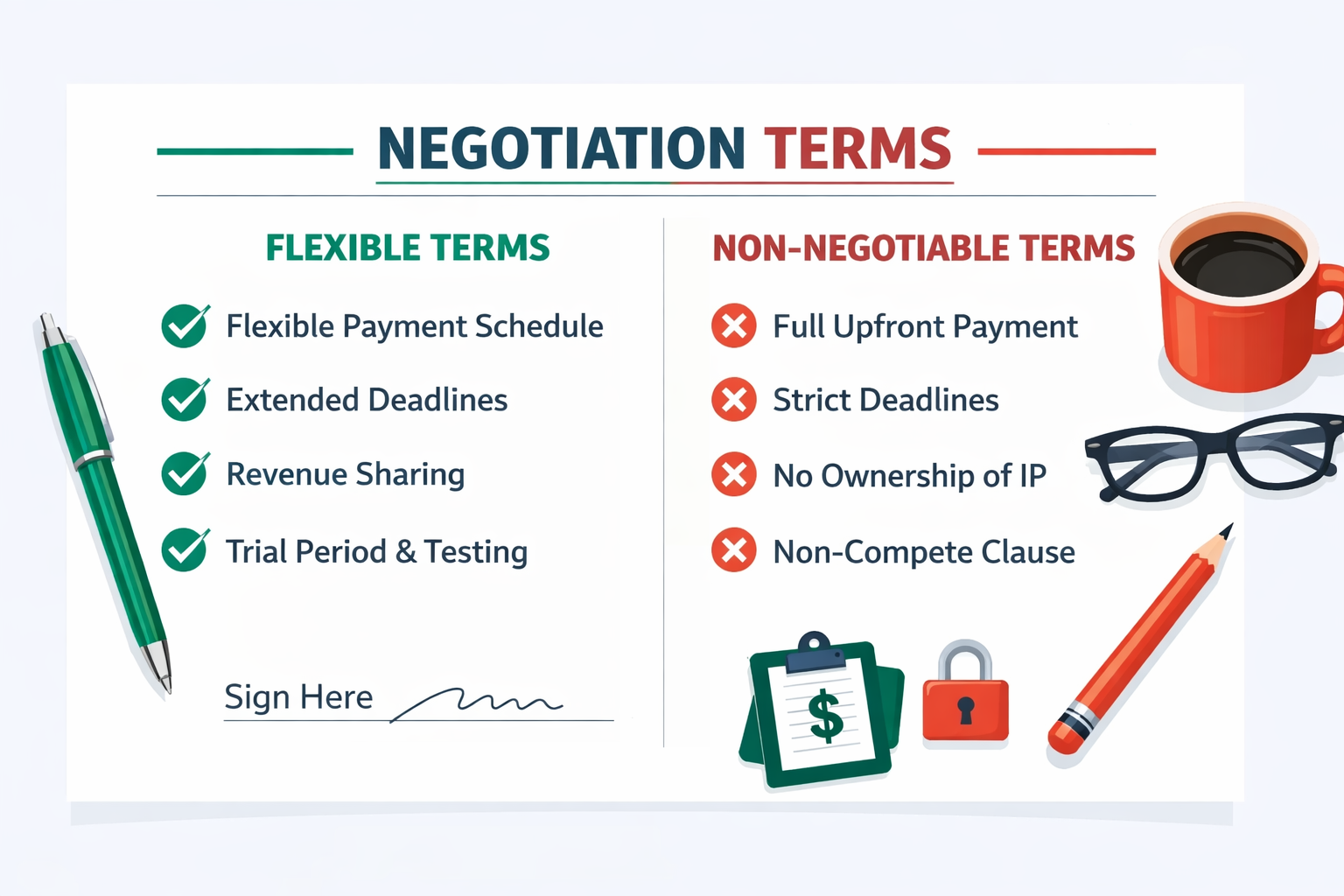
After negotiating these contracts daily, here’s my working map.
5 Terms You Can Push Back On
1. Liability Cap
Most enterprise agreements start with unlimited liability – meaning if something goes wrong, you’re exposed for everything. That’s not a reasonable starting position for a vendor your size.
Push for a cap equal to the contract value. Enterprises will often accept this, especially for software or services agreements. In some cases, you can negotiate up to 2x contract value.
Real example: A client of mine recently pushed back on an unlimited liability clause and got it capped at 2x the annual contract value. Their exposure went from theoretically unlimited to $180,000. Same deal, same customer, same timeline – just one negotiated term.
2. Payment Terms
Net 90 is standard in many enterprise agreements. Net 90 is also a cash flow problem for a $2M company.
Net 30 to net 45 is reasonable to request. Larger enterprises often have flexibility here, particularly if you’re a new vendor they want to onboard smoothly. Frame it as operational, not adversarial – “our invoicing system is set up for net 30, would that work on your end?”
3. IP Ownership
This one matters more than most founders realize. Some enterprise agreements include language that gives the customer ownership of anything you create specifically for them – including improvements to your core product.
Read the IP clauses carefully. You should retain ownership of your underlying technology, methodologies, and any improvements you make to your existing platform. Work product created exclusively for them is a different conversation, but your core IP is not negotiable.
4. Termination Notice
Enterprises sometimes draft agreements with immediate termination rights for convenience. That’s a revenue cliff you can’t plan around.
Push for 60 to 90 days written notice for termination without cause. This gives you time to plan, backfill, or renegotiate. Most enterprises will accept this – it’s a reasonable operational request.
5. Warranty Scope
Standard enterprise agreements often include broad warranty language requiring your product to perform perfectly under all conditions. That’s not realistic for any software or services company.
Negotiate warranty language that covers reasonable performance under documented use cases, with a defined cure period before any breach claim can be made. “We warrant the product will perform materially in accordance with documentation” is defensible. “We warrant perfection” is not.
5 Terms That Are Usually Non-Negotiable
Their state jurisdiction. Enterprises have legal teams in their home state and won’t litigate in yours. Accept this one.
Arbitration requirements. Many large companies require binding arbitration for disputes. Fighting this rarely succeeds and signals you’re not a sophisticated vendor.
Indemnification framework. The structure of mutual indemnification (you cover your IP, they cover their misuse) is usually fixed. You can negotiate scope, but not the overall framework.
Security and compliance standards. If they require SOC 2 compliance, specific data handling protocols, or security certifications, these are non-negotiable. Budget for them or lose the deal.
Audit rights. Enterprise customers often retain the right to audit your compliance with the agreement. This is standard and fighting it raises red flags about what you’re trying to hide.
The Framing That Makes Negotiation Work
The goal isn’t to win every point. It’s to protect your business on the terms that matter most while keeping deal velocity high.
Pick your two or three most important issues, make clear and professional requests, and let the rest go. Enterprises close deals with vendors who are reasonable and prepared – not vendors who redline every clause.
The founders I see struggle with enterprise negotiations are usually doing one of two things: accepting everything out of fear, or fighting everything out of principle. Neither approach serves your business.
What’s the term you’ve had the hardest time pushing back on in enterprise deals? Drop it in the comments – I’m curious what patterns others are seeing.
About The Garcia-Zamor Law Firm: We’re the fractional in-house counsel for growing companies – combining business law with intellectual property expertise that most providers can’t offer. Ruy Garcia-Zamor leads business strategy and contract negotiation, Elliott Alderman (former U.S. Copyright Office attorney, outside counsel to the Miami Heat) handles intellectual property, and Claudia Castillo specializes in employment law. We negotiate enterprise contracts daily – and we know what customers will accept versus what kills deals. Visit garcia-zamor.com or call (410) 531-9853.